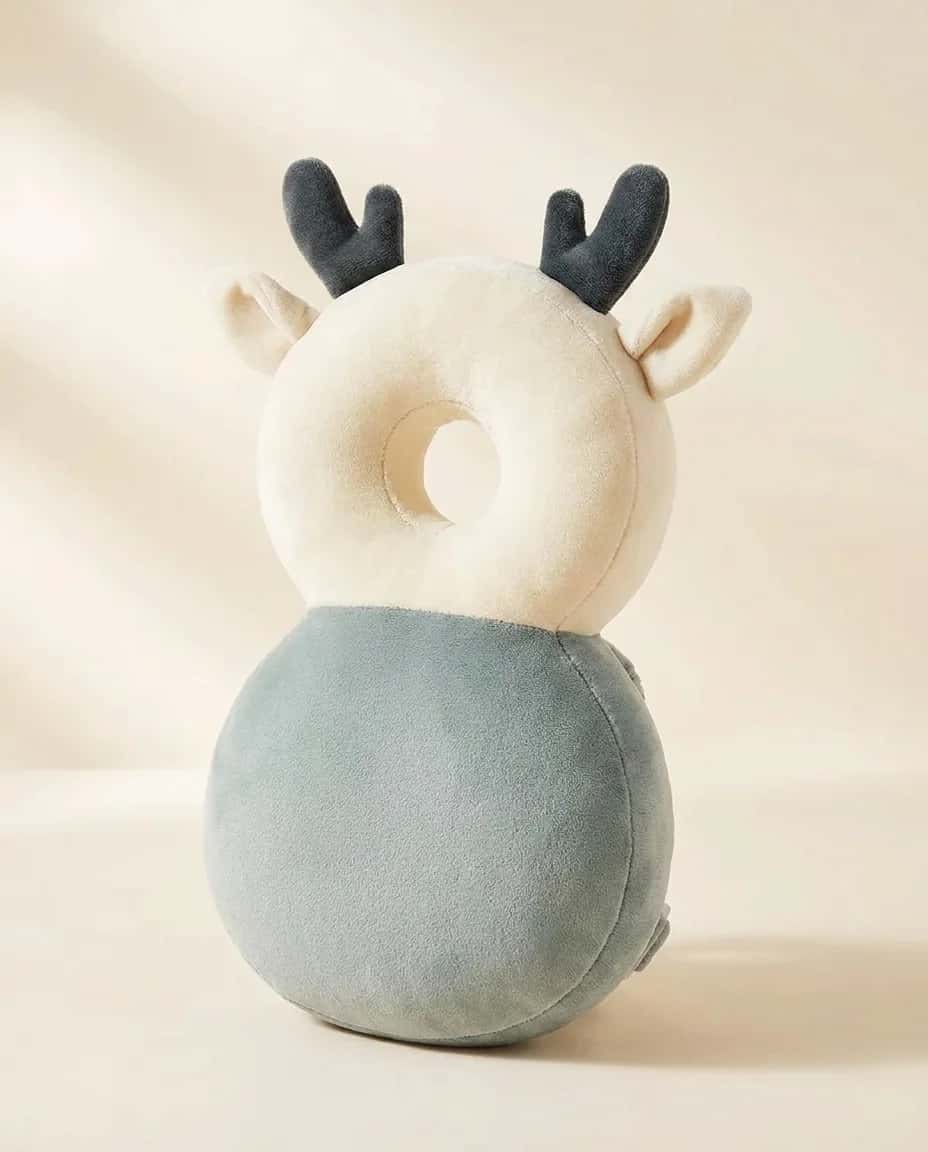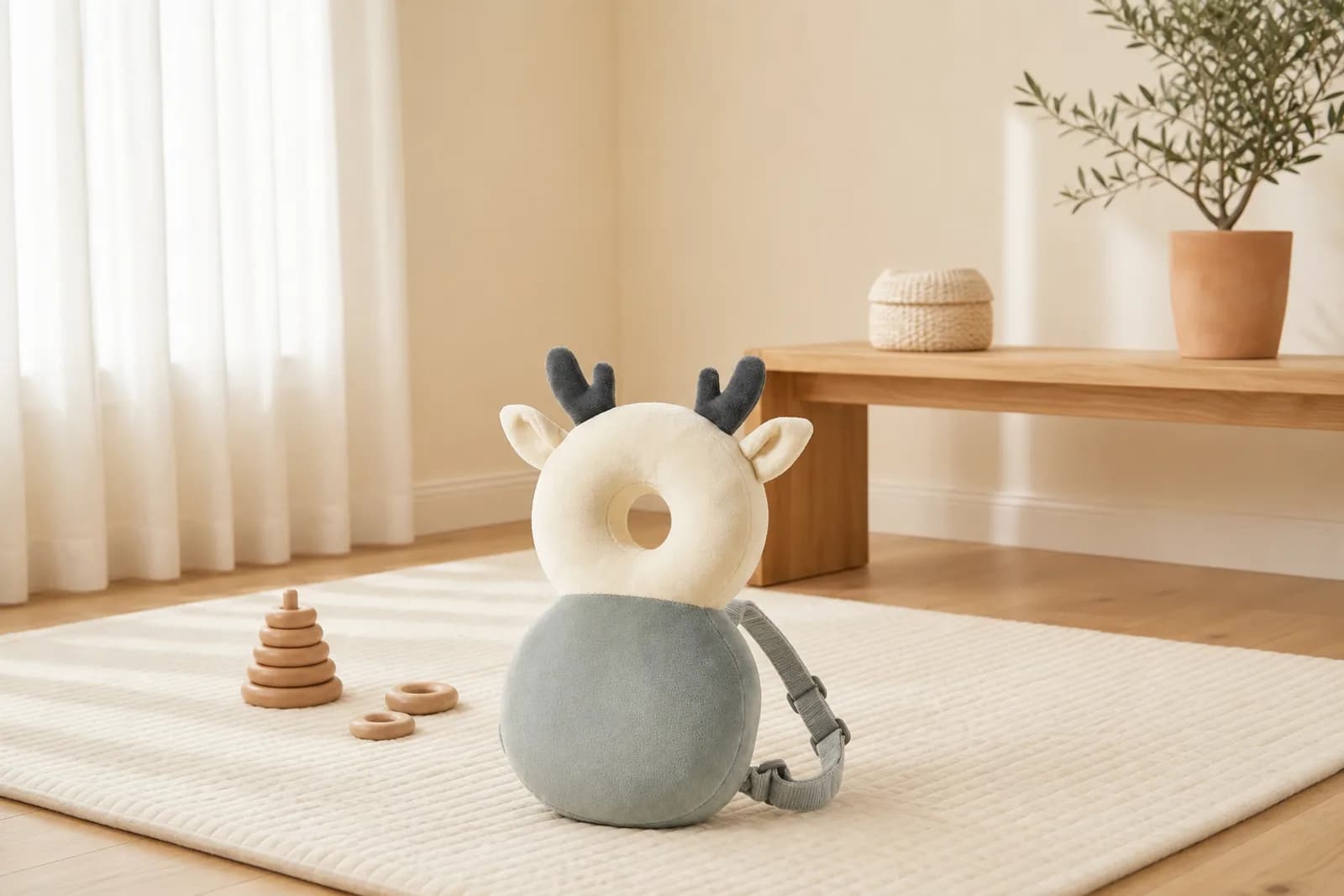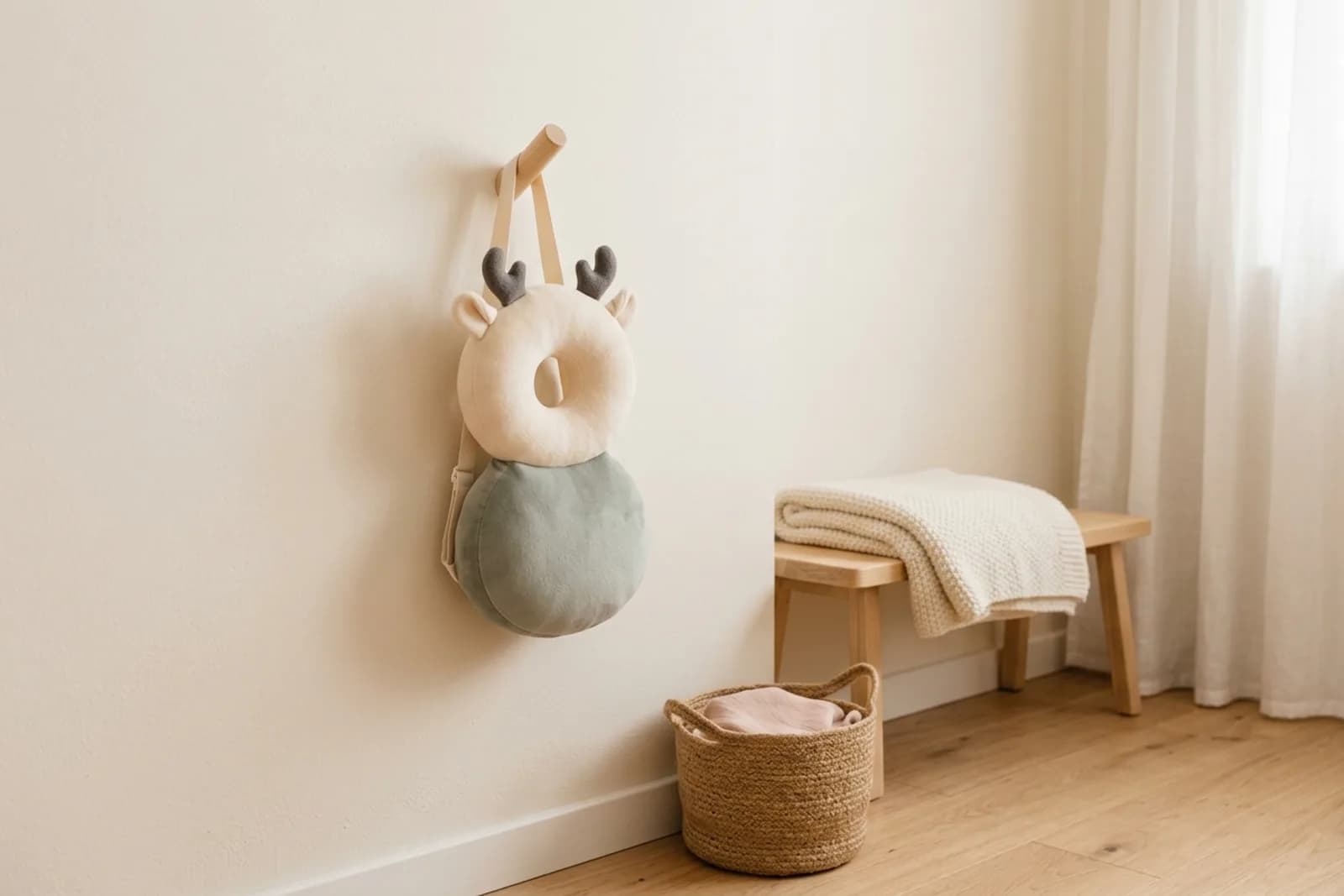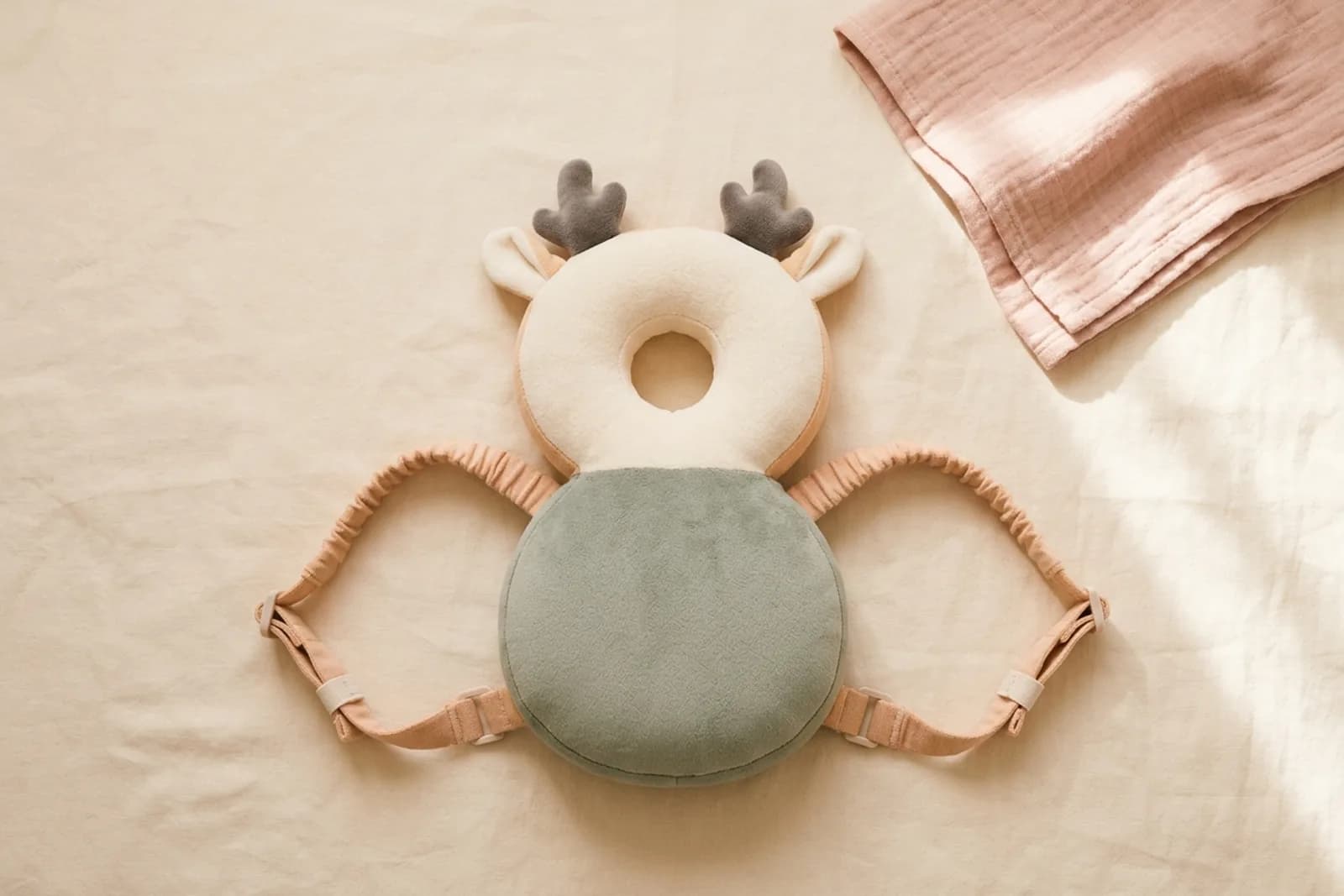
Only put the fall cushion on for awake, supervised practice on the floor. Adjust both straps to the same length over ordinary clothes, keep them flat and let nothing run along the neck or armpit. If the fit is right, your baby moves exactly the same with it as without. Off for sleep, travel and car seats.
What to remember
- The cushion goes on just before practice and comes straight off again when play stops.
- Adjust left and right separately and to the same length, over the clothes your baby is wearing at that moment.
- A good fit shows in behaviour: your baby crawls, rolls and sits down just like always.
- For sleep, car seats, bike seats, carriers and pushchairs the cushion comes off, without exception.
When do you put the fall cushion on, and when not?
The fall cushion belongs to one moment: awake practice on the floor, with an adult within arm's reach. You put it on when your baby starts crawling, pulling up or trying steps in a room you have already made safe, and you take it off as soon as that play session is over. That keeps it a briefly worn accessory instead of something that stays on all day.
There are moments where the cushion simply does not belong. In bed, in a car or bike seat, in a carrier or in the pushchair your child is lying down or held by a harness. A cushion with its own straps adds no useful padding there, but it does add risk, because harnesses are tested to fit without extra soft layers in between.
- Yes: awake, on the floor, in a tidy room, with you close by.
- No: sleeping, car seat, bike seat, carrier, pushchair or playpen without supervision.
- No: climbing, sliding or any play where a strap could catch on something.
- Unsure? Then the cushion is not needed. The safe room does the real work.
How do you adjust the straps properly?
Lay the cushion flat first, with the straps opened out to both sides. That way you see at a glance whether left and right are the same length. Adjust them before your baby wears it: a wriggling child and a buckle at the same time is asking for a crooked setting.
Then put the cushion on over the clothes your baby is wearing right now and pull the straps up evenly until they lie flat on the shoulders. The round head pad belongs behind the back of the head, not hovering above it and not pressing into the neck. Always correct both sides at once: pull on the right only and the whole thing turns towards one shoulder and sits crooked within a minute.
If your baby wears a thin bodysuit one day and a thick jumper the next, the adjustment changes with it. So check each time instead of setting it once and forgetting about it.
Short video: from close up you see how softly the filling gives and how the elastic straps run across the back.
How can you tell the fit is right?
The best test is not a tape measure but behaviour. Put your baby down and watch for a minute. Does he crawl like always, roll freely from tummy to back, sit down without hesitating and reach equally far with both arms? Then the cushion is doing its job: moving along without being noticed.
After that, look along the edges. The straps lie flat, do not run along the neck, mouth or armpit, and no long loops hang loose. The cushion follows the back and does not push the head forward. The skin under the straps looks normal afterwards, with no red lines or deep marks.
- Both straps the same length, flat on the shoulders, no twist in the strap.
- Nothing along the neck, mouth or armpit and no loose loop that could catch.
- The head pad sits behind the back of the head, not above it and not in the neck.
- Your baby moves, breathes and plays the same as without the cushion.
What if the cushion is too tight or too loose?
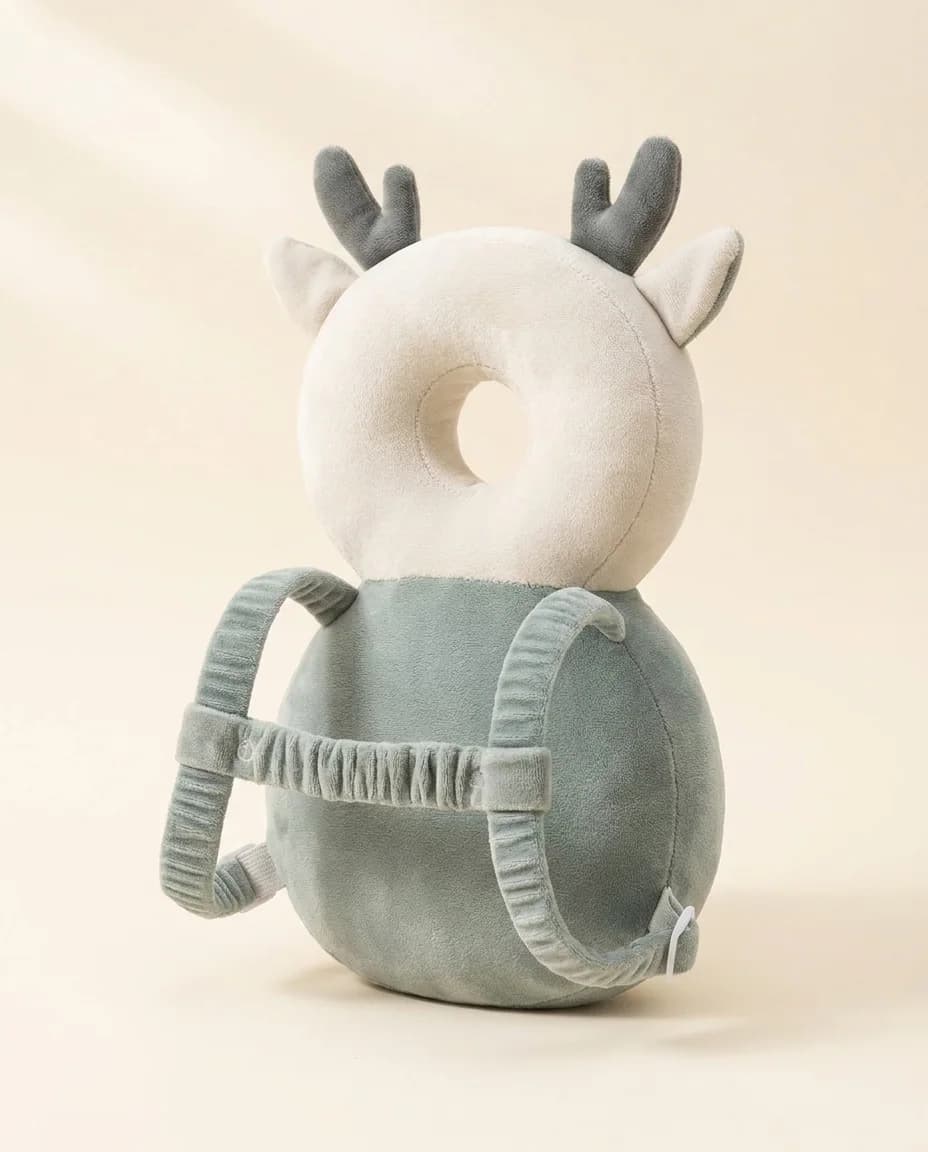
Too tight shows on the body: red lines afterwards, arms that cannot come forward freely, a baby who lifts his shoulders or suddenly goes limp. If that is what you see, adjust until it is comfortable. If you cannot manage that without the cushion starting to slip, it does not fit at this moment and you are better off leaving it off.
Too loose is when the cushion slides to one shoulder with every movement, turns over the side or drops down to the bottom. The padding is then no longer where you want it, and your baby can slip an arm through a slack strap. The same rule applies: adjust evenly and accept it when it will not work. Pulling tighter until it stays put is not a solution, because an accessory that only stays in place by pinching does not fit.
Which mistakes do parents make most often?
Most slips are small and easy to put right. They mainly happen in a hurry, in between two other things.
The last one in the list below is the most important. A fall cushion is a comfort accessory and not a second pair of eyes. VeiligheidNL stresses that room to move and removing the big risks do the work together. Supervision and a safe floor stay the first measure in that, not something you can buy off with a product.
- Setting it once and never looking again, while your baby grows and the clothes change.
- Putting the cushion over a thick coat, so the adjustment means nothing the moment that layer comes off.
- Pulling on one strap only, so the whole thing drops crooked towards one shoulder.
- Leaving the cushion on during meals, in the pushchair or during an unexpected nap on the sofa.
- Thinking the cushion keeps an eye on things so you can quickly do something else.
When does the cushion have to come off straight away?
Take the cushion off without hesitating as soon as your baby falls asleep, even when that happens on the sofa or in the pushchair. A cot has no place for cushions, straps or other loose soft materials; that is the core of safe sleep advice. The same goes for every moment your child is held by a belt or harness.
There are stopping points during play too. Take the cushion away if a strap moves towards the neck or face, if your baby keeps catching on it, gets visibly warm or is clearly bothered by it. And take it away when it is worn out: a seam that has come loose, lumpy filling or a strap that no longer stays in place means the accessory is no longer doing its job.
Frequently asked questions
How tight should a fall cushion be?
Tight enough not to shift and loose enough that your baby does not notice it. The straps lie flat on the shoulders, do not run along the neck or armpit and leave no red lines. When it is right, your baby crawls, rolls and sits down exactly as without the cushion. If you cannot get that combination, leave it off for now.
Should the fall cushion go over or under clothing?
Over clothing, and over the clothes your baby is wearing at that moment. Under a jumper or coat you cannot see how the straps lie and you cannot adjust them. If your child changes from a thin bodysuit to a thick jumper, adjust again: the same setting feels completely different over another layer.
Why does the cushion keep sliding to one side?
Almost always because one strap is shorter than the other, or because you corrected only one side while putting it on. Lay the cushion flat, set left and right to the same length again and only then put it on. If it keeps sliding while both straps are equal, the size does not fit at this moment.
Can my baby keep the fall cushion on during a nap?
No. Take the cushion off as soon as your baby falls asleep, including an unexpected nap on the sofa or in the pushchair. A cot has no place for cushions, straps or other loose soft things. If your child falls asleep with the cushion on, calmly take it away before you get on with your day.
Can the fall cushion stay on in the pushchair or car seat?
No. In a pushchair, car seat or bike seat your child is held by a belt or harness, and that fit is tested without extra soft layers in between. A cushion with its own straps does not belong there. Use it separately from travel, during awake practice on the floor with you nearby.
How often should I check the fit again?
Briefly every time you put it on, and a bit more thoroughly after a growth spurt, a wash or a change to thicker clothes. That takes half a minute: straps equal, nothing along the neck or armpit, cushion behind the back of the head. If you notice you keep having to pull tighter to keep it in place, that is a signal to stop.
Sources and review
The limits of use and the importance of a safe practice space follow VeiligheidNL and the WHO guidance on active floor play. The fit check describes how to look for yourself; the manual and label of your own cushion remain leading. MoshiGuard is a comfort accessory and not a medical device. Last content review: 1 August 2026.